Watchmaking artistry

From drawing to workbench

At Magny-en-Vexin, a B.R.M Chronographes watch is designed, machined, skeletonised, decorated, assembled and inspected in neighbouring workshops. Few manufactures cover this entire journey. Here is ours, stage by stage.

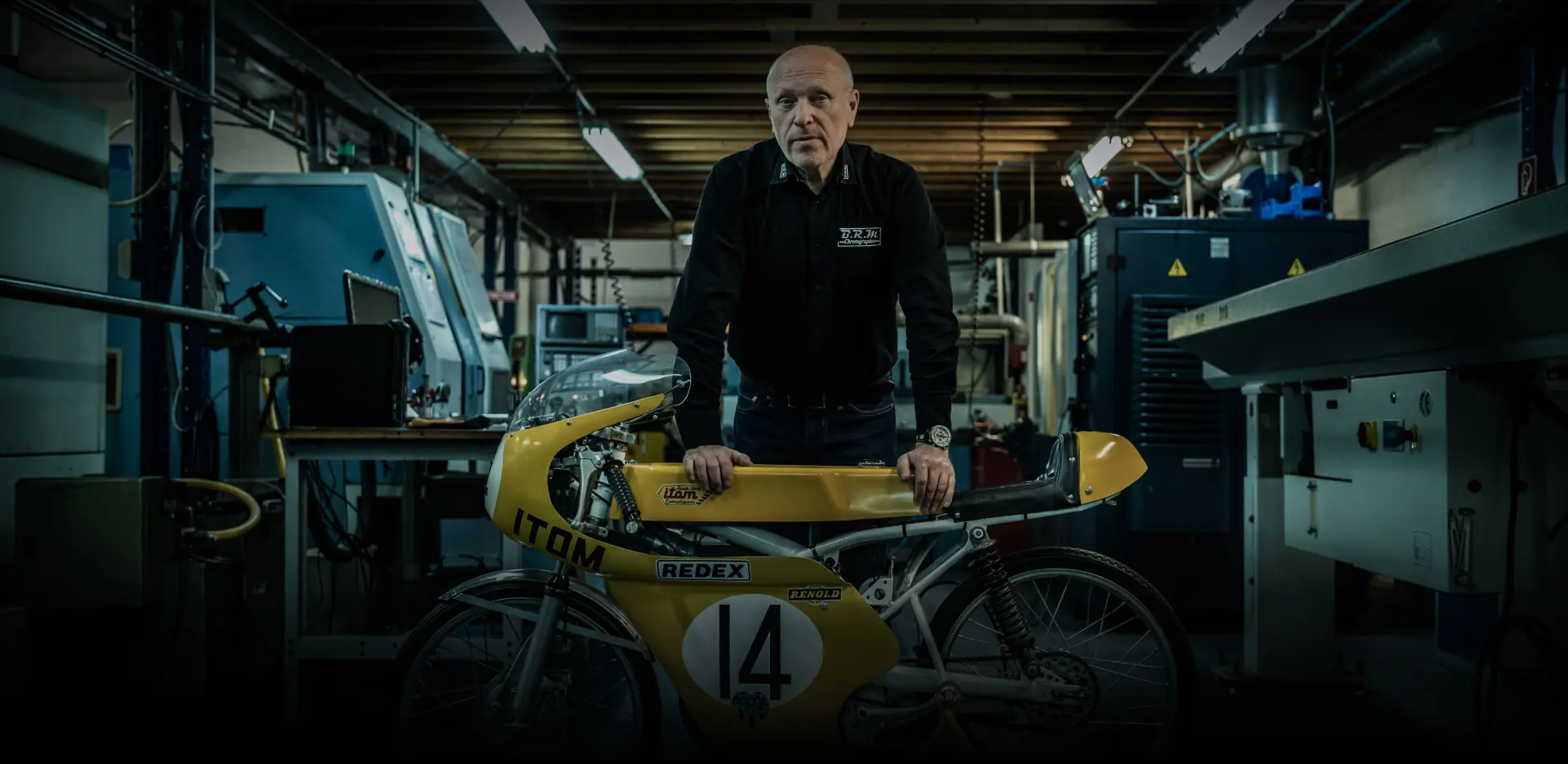
The manufacture's machining workshop: a man in black, leaning against a yellow racing motorcycle, in front of the machines

Machining, openworking, lacquering, assembling: in the same place.

Bernard Richards Manufacture · Magny-en-Vexin, since 1986

The journey of a watch

Six métiers, one roof

Design, machining, skeletonisation, finishing, assembly and testing are carried out a few metres from one another. A part machined next to the bench can be adjusted, modified or remade without waiting for a supplier.

  1. Design

    Each part of the watch has its drawing, designed in three dimensions.

  2. Machining

    Cases and parts are machined from the solid, to the nearest hundredth of a millimetre.

  3. Skeletonise

    Skeleton movements are openworked by hand in the workshop.

  4. Decoration

    Engraving, dial printed individually, lacquer applied by brush.

  5. To assemble

    Part by part, the movement suspended on its shock absorbers.

  6. Inspection

    Two inspections, one number, and return to the manufacture for servicing.

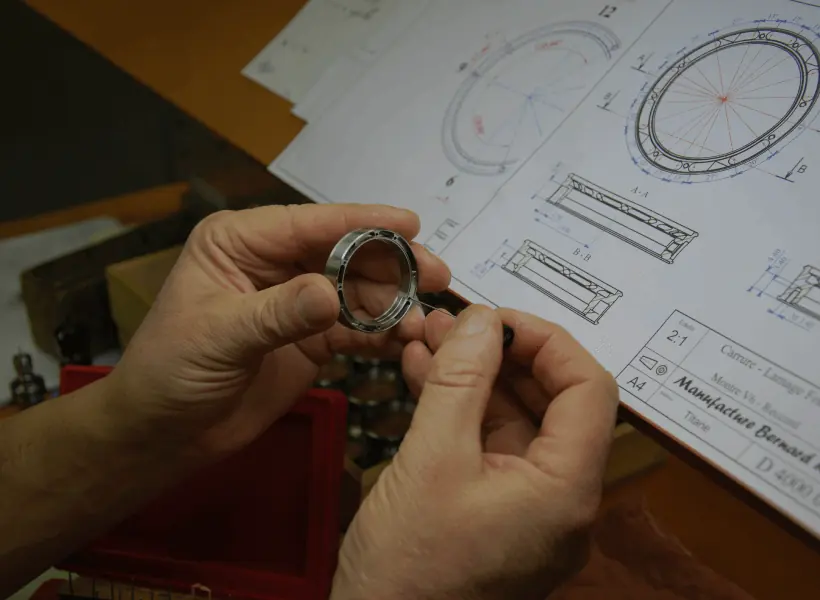
Hands holding a machined case middle above its technical drawing, with the Manufacture Bernard Richards cartouche

The design

Everything begins with a drawing

The first B.R.M was born from a sketch. In 2003, Bernard Richards could not find on the market the mechanical watch he envisaged: he designed the GP-44. Since then, every watch from the house begins with a drawing.

Each part then has its own drawing: the middle case, the lugs, the dial, the movement ring. They are drawn in-house, in three dimensions using TopSolid, down to the precise measurement. The machine programmes derive directly from these 3D drawings: the machining department, a few metres away, works from the drawing itself.

The construction in separate elements is decided at this stage: each part is conceived to be machined separately, then assembled. This is what makes it possible to combine carbon, titanium, Makrolon®, PVD-treated stainless steel or ceramic on a single watch.
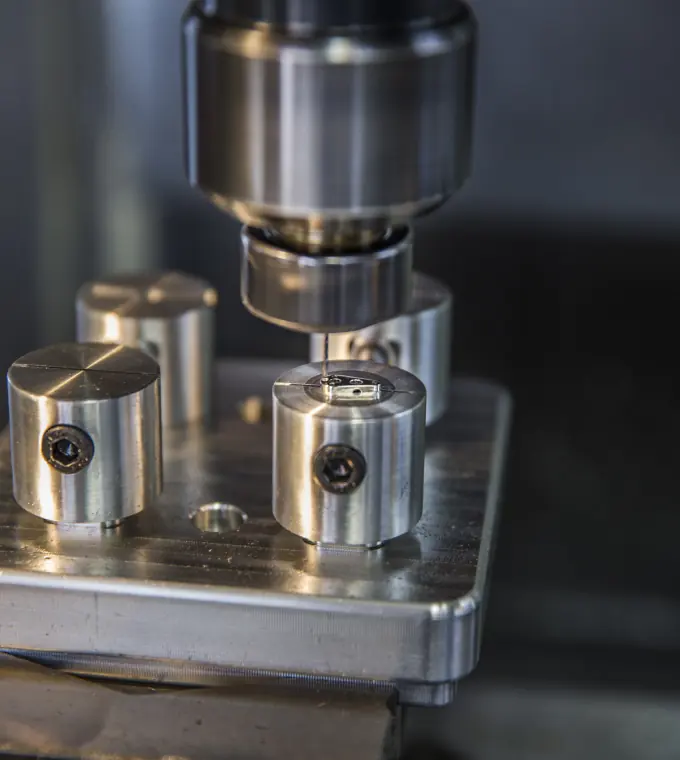
Metal parts on a tray, beneath the spindle of a numerically controlled machine
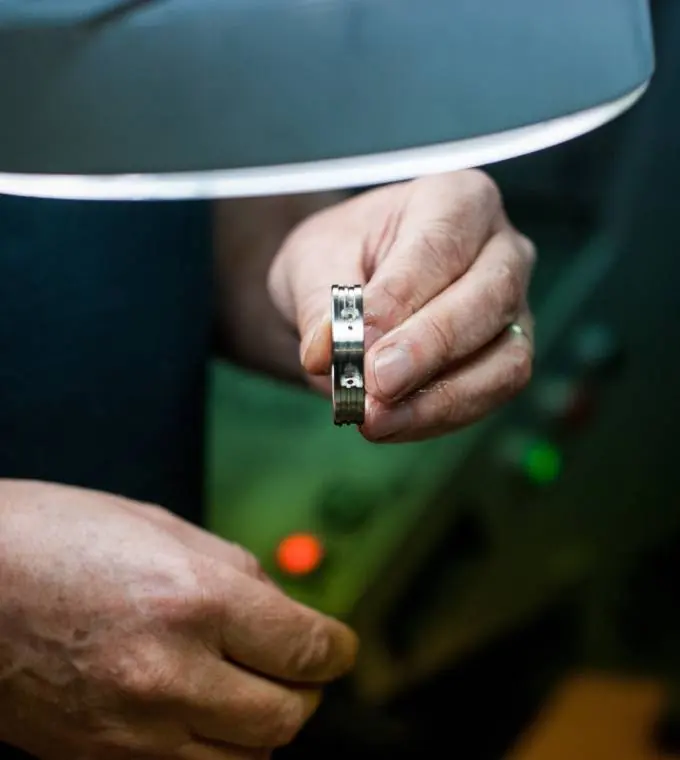
Under the workshop lamp, a hand holds a small machined component

Machining

Machined from the solid

The manufacture has its own machining centre: a fleet of fourteen digital machines, capable of machining up to eleven axes. Parts are machined from solid, to the nearest hundredth of a millimetre.

Each element is machined separately, then assembled. The lugs, for example, are machined separately and screwed to the case. This construction, borrowed from luxury automobile manufacture, makes it possible to treat each part in its own way, from its fabrication to its finishing.

Digital machines

Simultaneous machining

To the nearest millimetre

On the same machines

Not just cases

GP-44, 2003

The first B.R.M, machined on the house's first numerically controlled lathe.

DDF12

Inspired by brake discs. Its titanium case is, in itself, a machining challenge.

Golf Buckle

The pin buckle of the Golf watches : lightened, machined from the solid, in nine parts.

Jewellery

The jewels are machined from titanium, on the machines that mill the cases.

Cylindre winder

Machined like an engine block, from a 20-kilogramme aluminium block, then painted and oven-cured.

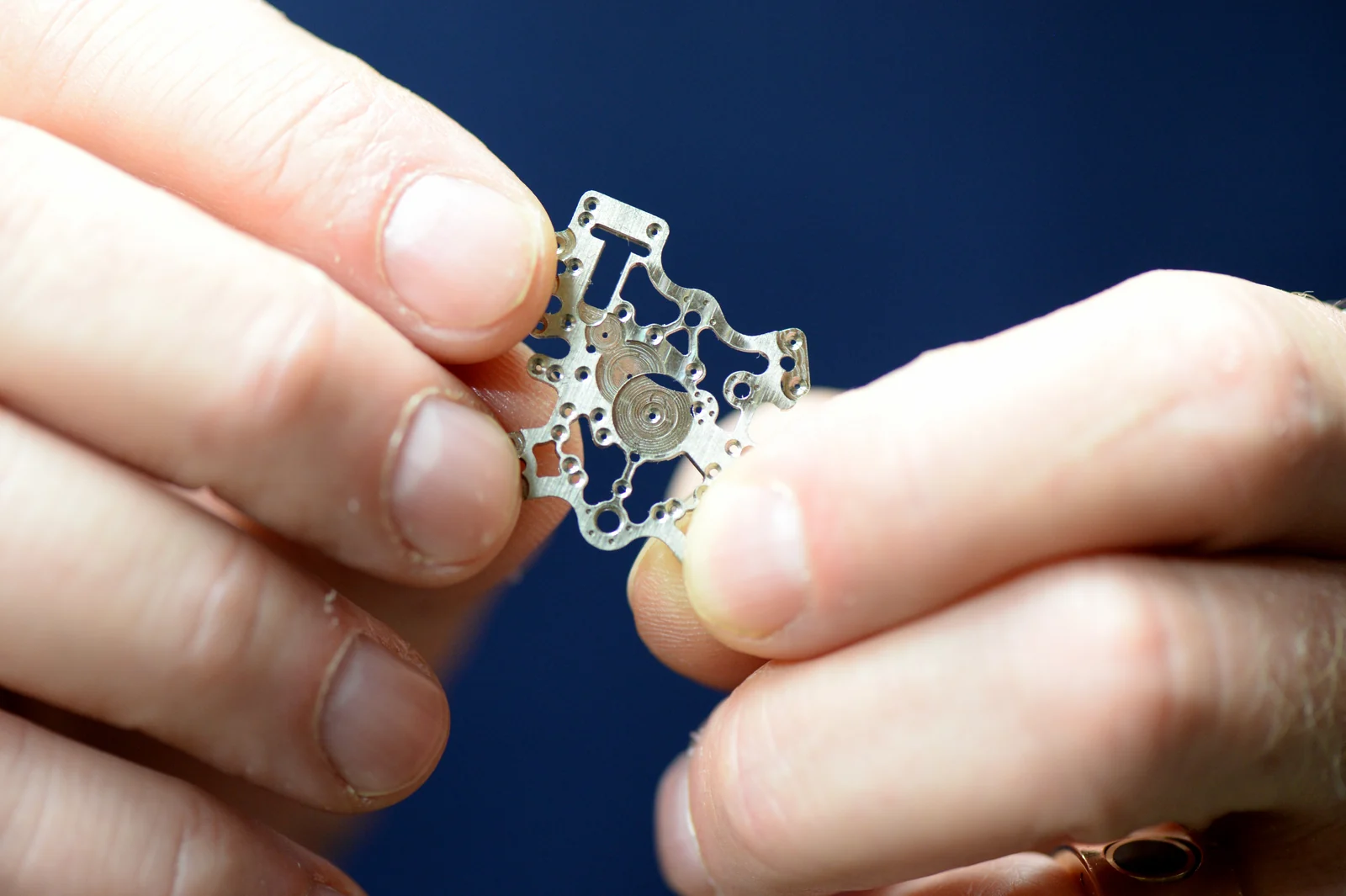
Skeletonised movement bridge held between a watchmaker's fingers
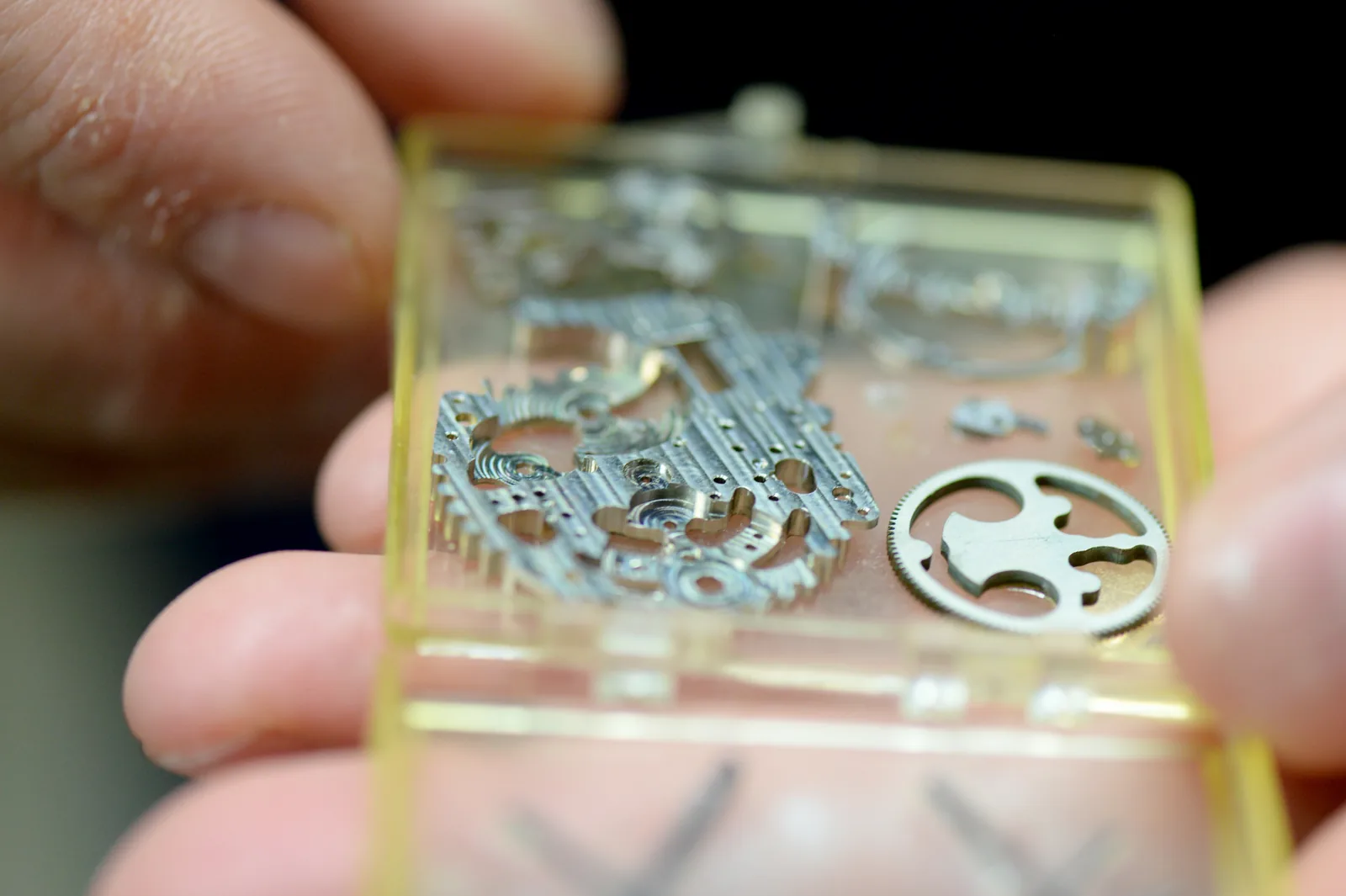
Box of skeletonised parts (chronograph bridge, wheel, openworked bridges) held between the fingers

Skeletonisation

Retaining only what works

To skeletonise is to remove. On the bridges and main plate, the workshop removes material until only what works remains. Each skeleton movement is conceived, then skeletonised by hand by the workshop teams.

Three automatic calibres pass through the workbench in this way: the ETA 2824-2 of the V6-44-SA, DDF6 and GF6, the ETA 2671 of the GF7, and the Valjoux 7753 chronograph of the MK-44 and V12-46-SA. On the specifications, they bear the mention "skeletonised by BRM". These are the manufacture's own movements: all the skeleton calibres in the collection come from this workbench.

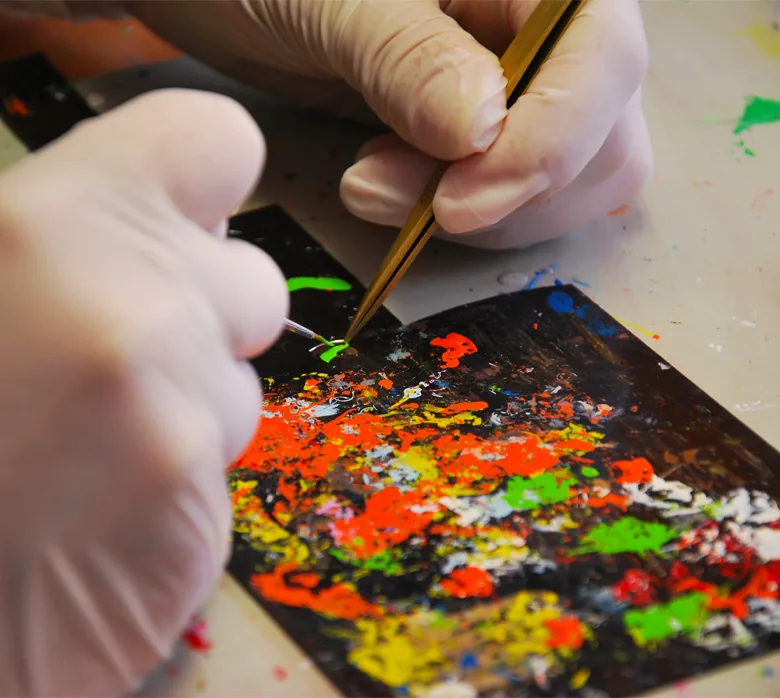
Gloved hand applying lacquer with a fine brush, on a multicoloured test palette

04 · Finishing

Colour is applied by hand

Once machined, the watch passes through other hands. Before assembly, it follows a precise order: engraving first, then, on skeleton models, the cutting of the dial, done by hand, and finally its printing.

  1. Engraving

    On the surface and in depth, carried out in the workshop: on the oscillating weight, the case back crystal or the crown. A name, a date, a motto.

  2. Dial printed individually

    Dials are printed one by one on UV printing machines installed at the manufacture. This is what makes a bespoke dial possible, including a company or racing team logo.

  3. Lacquer applied by hand

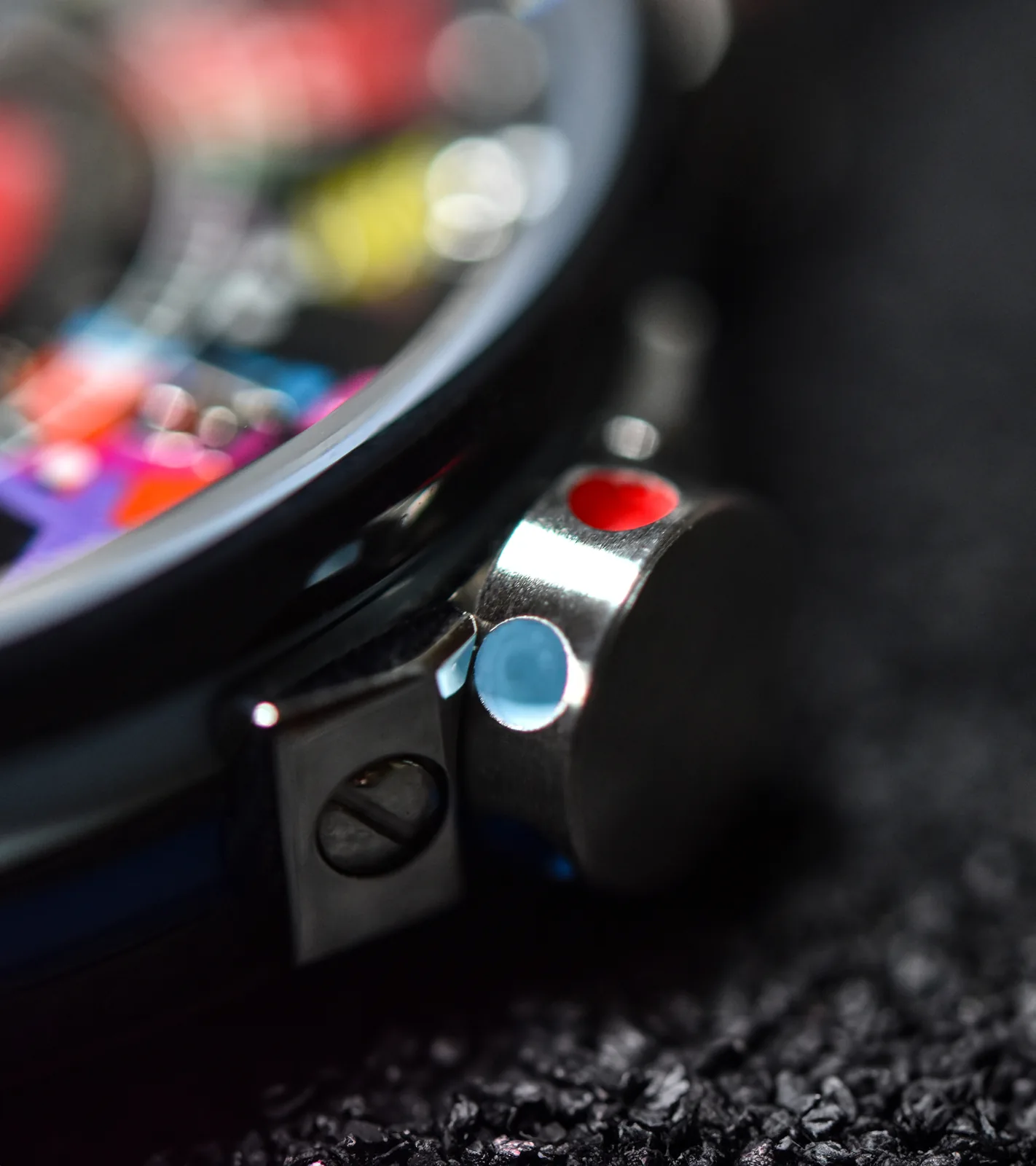
    Epoxy lacquer applied by brush then oven-baked, on the case, crown, pushers or springs. A shade can be reproduced from its Pantone reference, including that of a car body.

  4. Polishing, circular graining, stone-setting

    The skills recognised by the Entreprise du Patrimoine Vivant label, carried out at the bench by the house's craftsmen.

Close-up of the crown and lugs of an Art Car watch, red and sky-blue lacquer dots
The lacquer, applied point by point on the crown and the lugs.
Close-up of the chronograph dial of the V12-44 Titane Art Car: beams of colour, counters, skeletonised hands
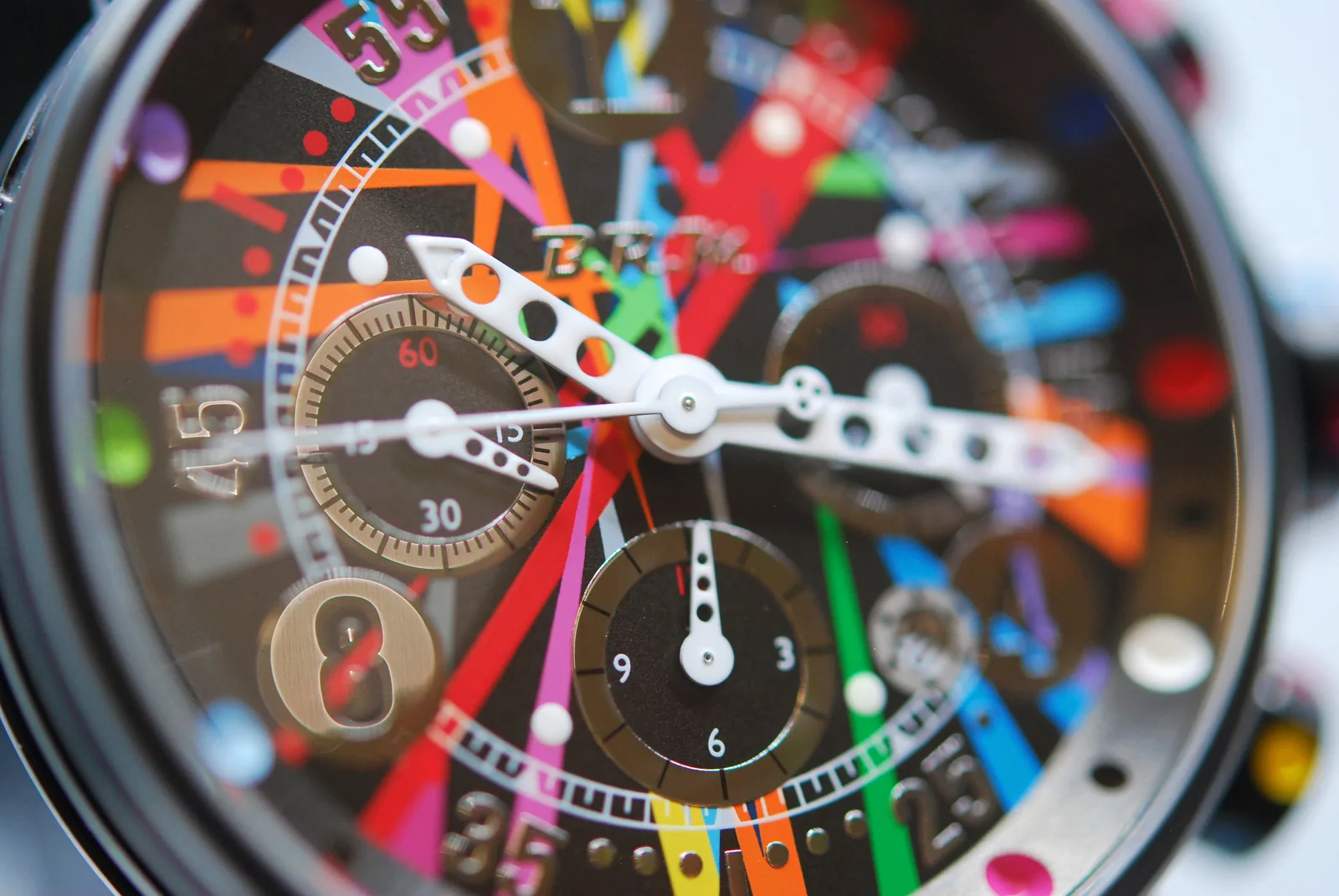
A dial from the Art Car collection, printed at the manufacture.
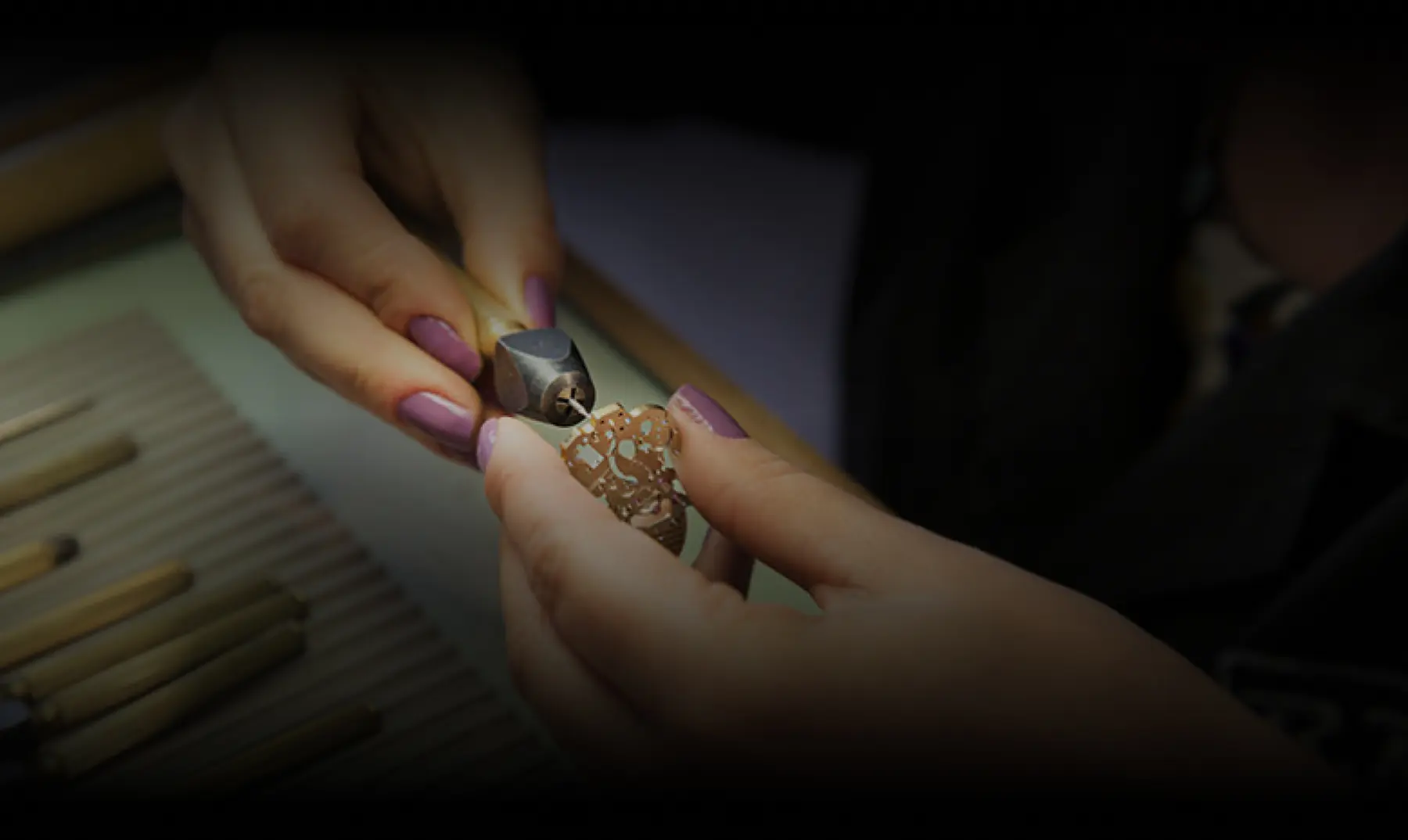
A craftswoman polishing a skeletonised component at the workbench
Polishing an openworked part at the bench.
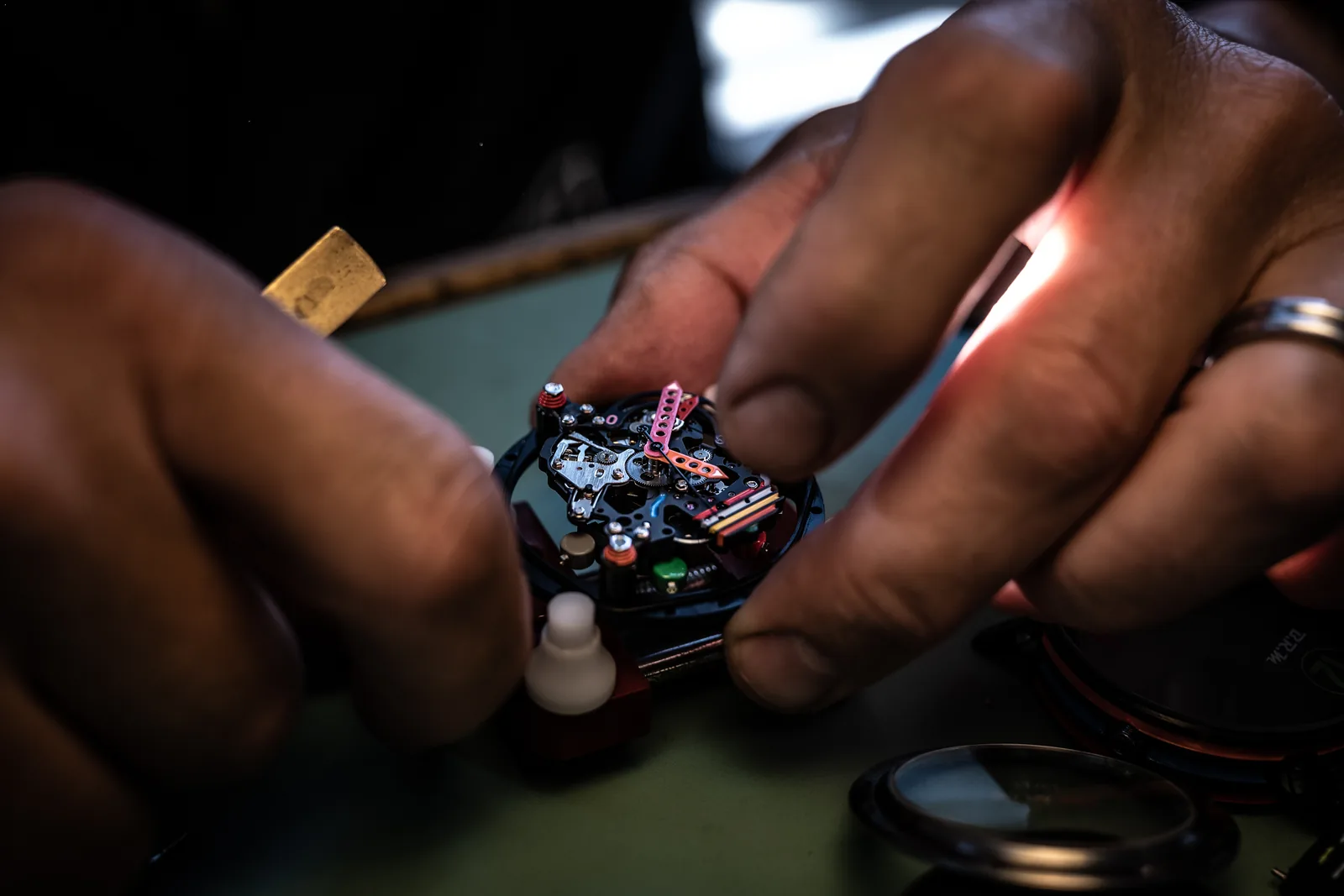
Watchmaker's hands assembling a movement in the workshop
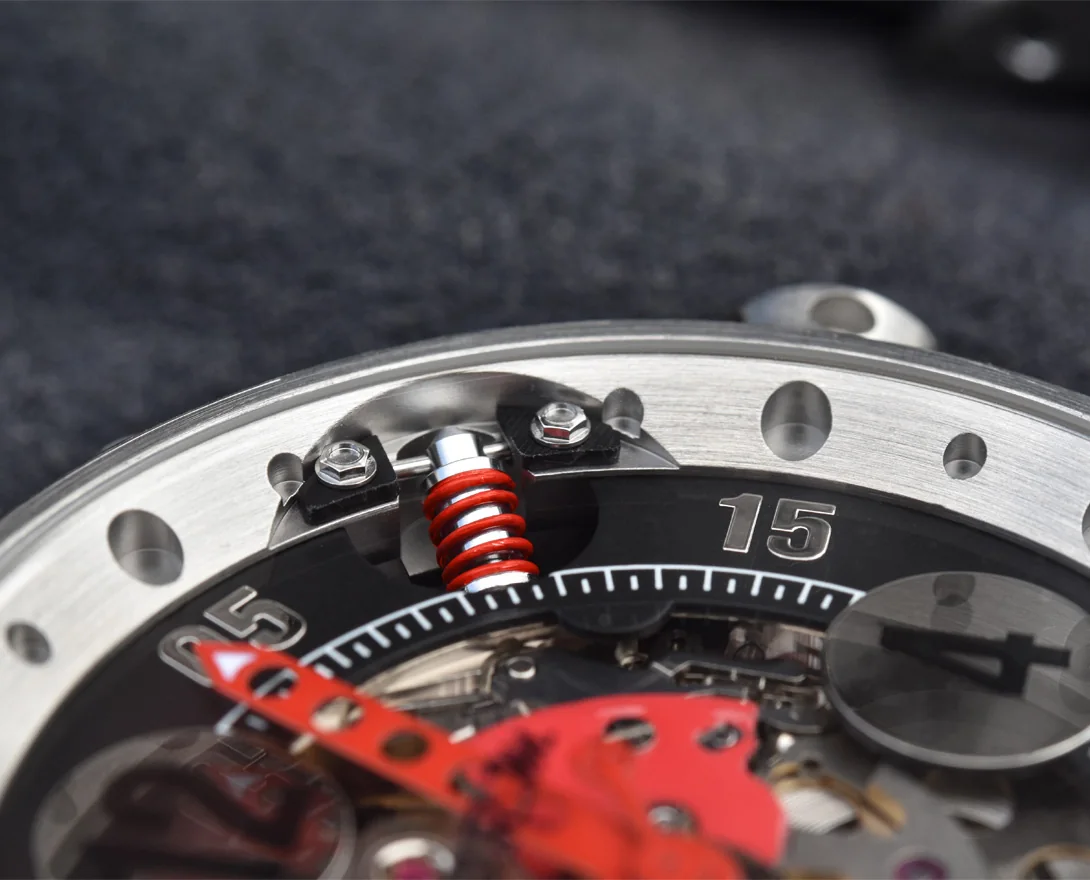
Red spring shock absorber between the case and the skeletonised movement, close-up

Casing and assembly

Part by part, at the bench

Middle case, movement ring, printed dial, movement: everything comes together on the workbench. Four watchmakers assemble them; each watch is entrusted to one of them, who assembles it part by part and regulates it in the workshop. It is made to order: allow six to eight weeks, regardless of the model.

At B.R.M, the calibre is never screwed directly to the middle case. The movement ring rests on shock absorbers, at least three on the case back, on all the manufacture's watches. The movement is suspended within the case; this is why so many dials are openworked: there is nothing to hide.

Suspending a movement

Three ways of doing

Shock Absorbers

Six helical steel springs, three at the front, three at the back, spaced 120° apart. The three at the front pass through the dial. Introduced in 2014 with the V6-44-SA.

Understanding the mechanism

Silent-blocs

Three small silent-blocs in place of the springs. A different mechanism, not a different finish: this is the suspension of the V6-44-SLB.

Full-Floating

On the FF39-40, the movement is held by five nitrile silent-blocs and two straps, which regulate its shock protection both vertically and horizontally. On the skeletonised carbon GF6, the "full-floating" balance combines a self-regulating mass and six dampers.

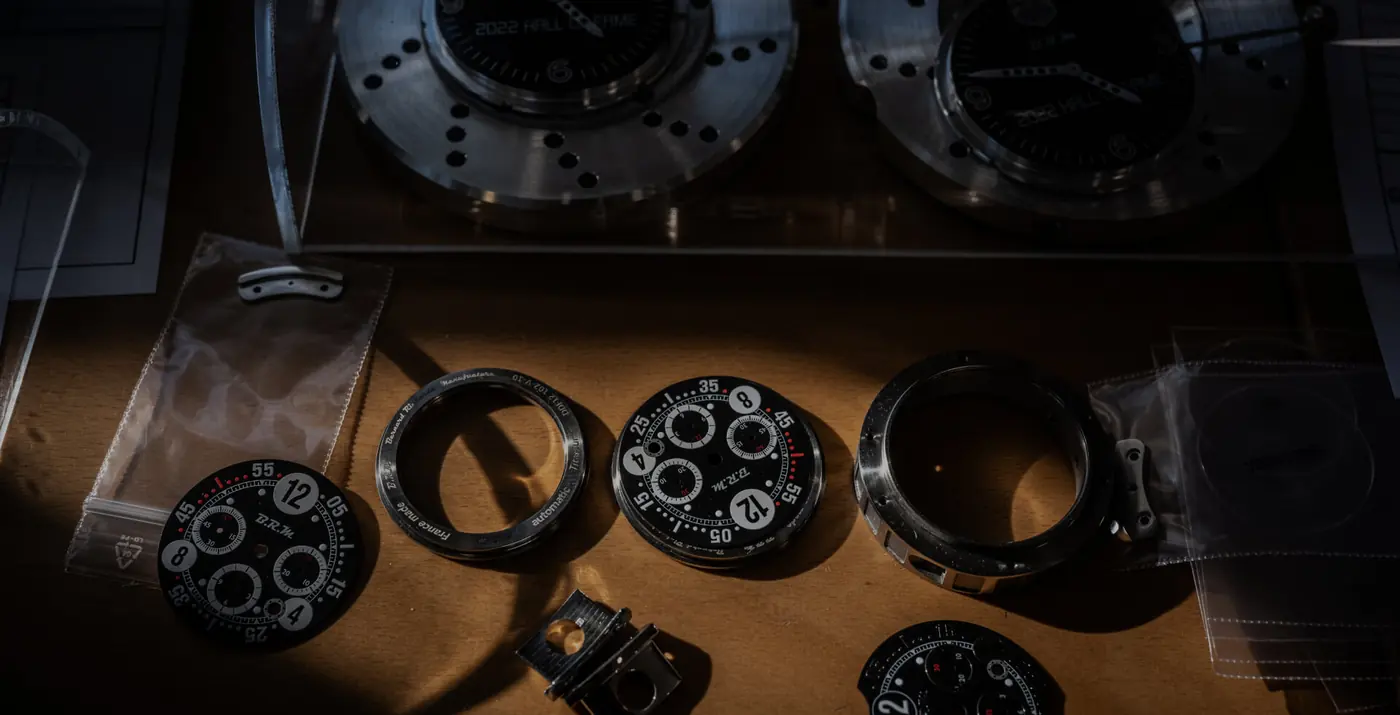
Dials, middle cases and parts in sachets placed on the workbench, before assembly
Before assembly: dials, middle cases and small parts await on the workbench.
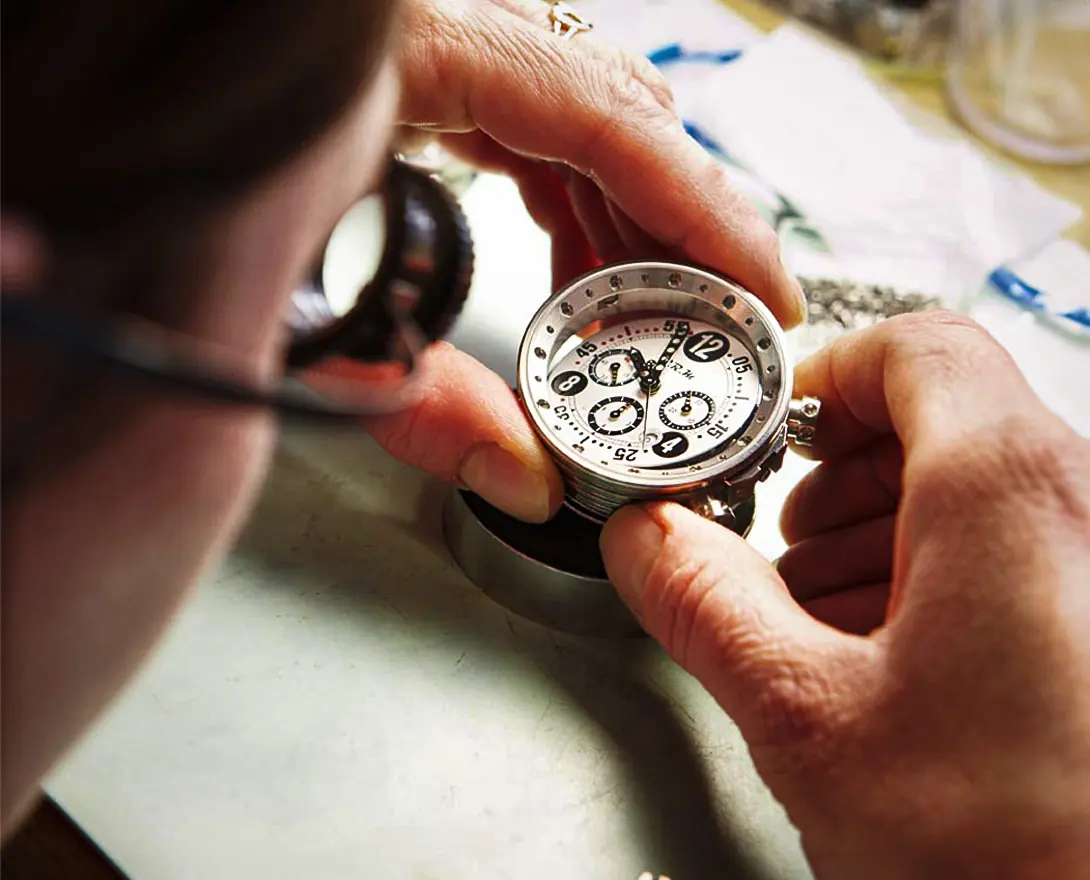
A watchmaker, loupe to eye, examines a B.R.M chronograph with white dial
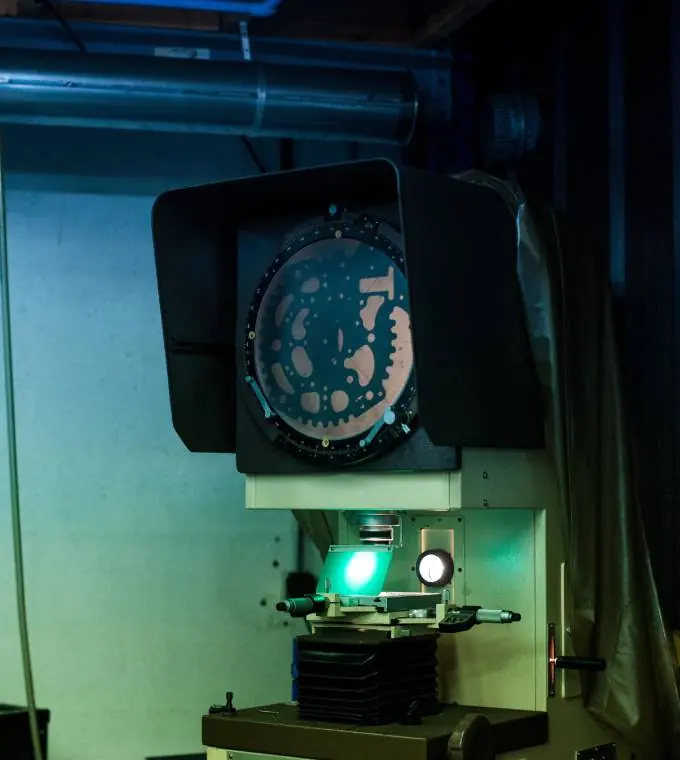
The workshop's profile projector: the outline of an openworked part enlarged on the screen

Testing and after-sales service

Inspected, numbered, tracked

Once assembled and regulated, the watch undergoes the workshop's quality control in two stages: a technical inspection, followed by an aesthetic inspection. It is photographed from the front and back, and these photographs remain linked to its serial number.

It then receives its number and leaves the workshop with a three-year warranty, in addition to the statutory warranty of conformity.

And when it returns
  • It returns to Magny-en-Vexin, into the hands of those who made it.
  • Diagnosis, then quotation within two weeks on average: nothing is started without your approval.
  • Genuine parts exclusively, water resistance testing by pressure test.
  • The repair is guaranteed for one year.
After-sales service

Complete transparency

What comes from elsewhere

This is the question to ask any brand that claims to be made in France. At B.R.M, the answer is written on every specification sheet.

What a French manufacture does
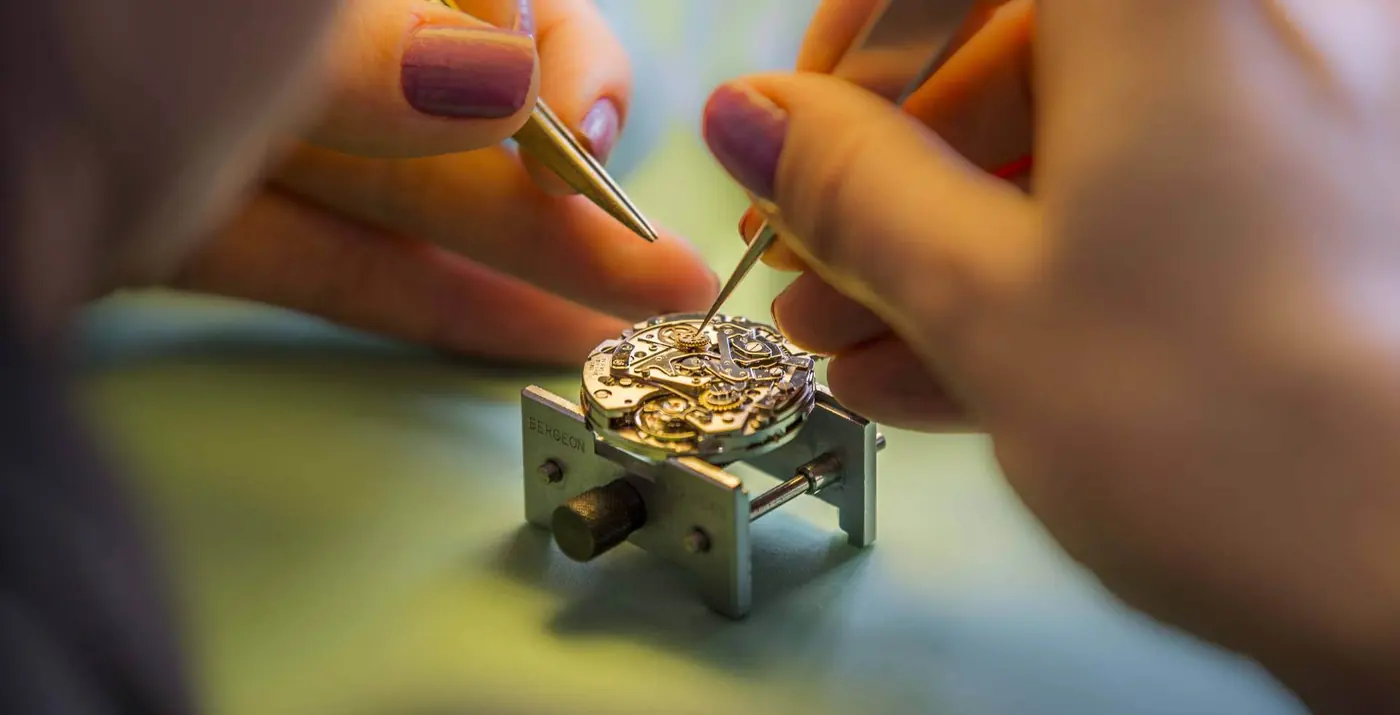
Watchmaker's hands working with tweezers on a movement placed on its holder

Yours

The same journey, made to your measure

The configurator allows you to compose a watch element by element, with the price displayed at each choice. The workshop then cuts, decorates and assembles it in Magny-en-Vexin.

Entreprise du Patrimoine Vivant Label The manufacture is distinguished Entreprise du Patrimoine Vivant by the Institut National des Métiers d'Art and the Ministry of the Economy and Finance.

Find the retailer nearest to you

Find a retailer

Engraving upon request

On the oscillating weight or the sapphire case-back.

Insured delivery

Tracked shipment, in France and internationally.

3-year warranty

In addition to the statutory warranty of conformity.

Home›The house of B.R.M›Watchmaking artistry